
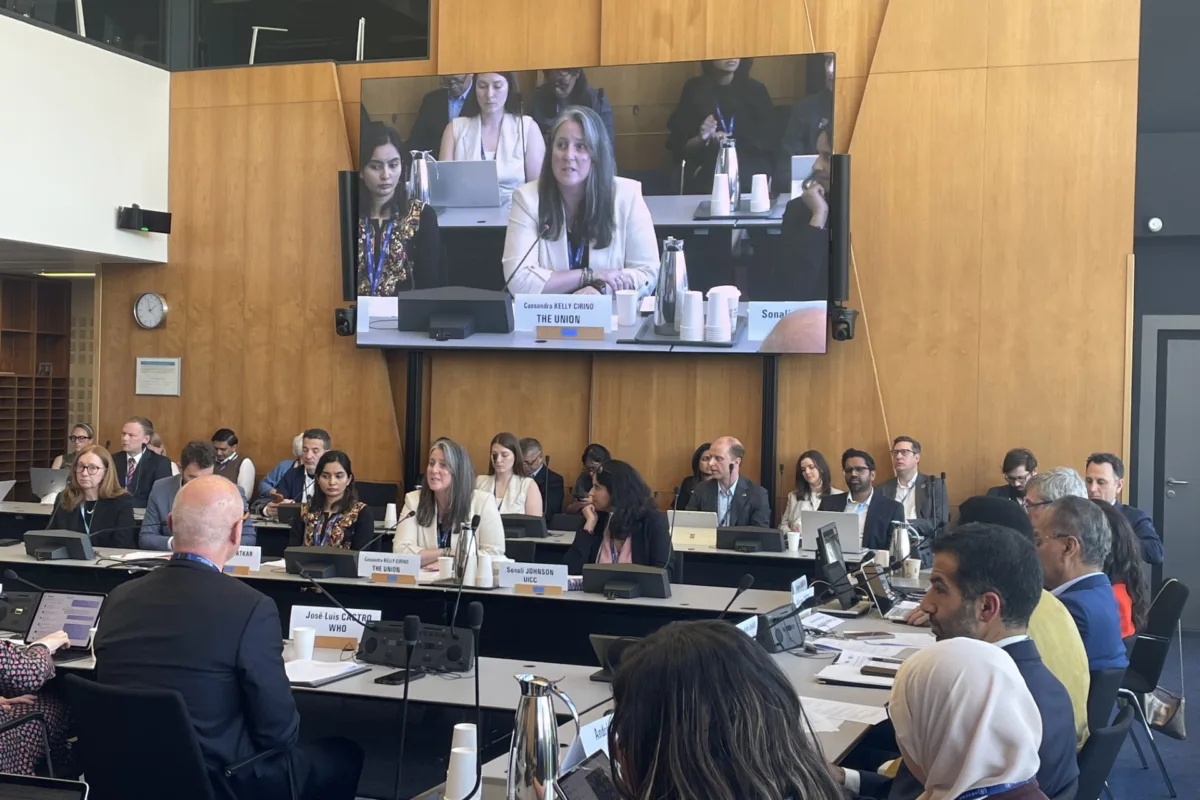
The Union delivered the following intervention on behalf of The Union and FIRS during our official side event at the 79th World Health Assembly, From Global Commitments to Integrated Lung Health Action: Advancing early diagnosis of lung cancer and access to inhaled medicines for COPD and asthma.
Excellencies, distinguished delegates, colleagues,
Today, I speak on behalf of The International Union Against Tuberculosis and Lung Disease and the Forum of International Respiratory Societies to draw attention to one of the world’s largest — yet most neglected — health challenges: chronic respiratory diseases.
More than 750 million people are living with asthma and COPD worldwide. Together, these conditions cause 3.8 million deaths every year — making chronic respiratory disease the third leading cause of death globally.
This burden spans the life course. COPD disproportionately affects adults and the older generation, we have over 100 million children under 15 living with asthma every day. This human toll is something we cannot ignore, the economic costs are staggering: The exhaustion, the financial burden, the uncertainty about access to care, access to treatment and access to diagnosis at the very beginning puts repetitive stress and strain on individuals, families, communities and health systems dealing with chronic illness that doesn’t ease up and increases pressure on health systems already under strain.
Without urgent action, this crisis will worsen dramatically. COPD deaths alone are projected to double by 2050, while the cumulative economic burden could approach 40 trillion US dollars.
Yet effective solutions exist.
Inhaled medicines are among the most effective, safe, and affordable interventions in modern medicine. They prevent deaths, reduce hospitalisations, and allow people living with asthma and COPD to lead healthy, productive lives. The evidence is unequivocal: when people can access appropriate inhaled therapies, health outcomes improve rapidly.
And yet, access remains profoundly unequal.
Only 26 percent of low-income countries report general availability of inhalers, compared to 93 percent of high-income countries. That number alone should cause us all to pause and question what is happening. In many settings, a month’s supply costs more than a week’s wages. Patients are forced into cycles of acute illness, emergency care, and repetitive, yet avoidable, hospitalisations.
For asthma in particular, this inequity is dangerous. Reliance on bronchodilator-only treatment without inhaled corticosteroids can mask symptoms while underlying inflammation worsens, increasing the risk of severe and potentially fatal attacks. Combination inhalers containing inhaled corticosteroids and formoterol are now standard first-line therapy in many high-income countries, yet they remain largely unavailable across much of the Global South.
The barriers are not only financial.
In many countries, inhaled medicines are absent from essential medicines lists, excluded from insurance reimbursement schemes, constrained by weak procurement systems, or blocked by outdated regulations that prevent primary health care workers from prescribing them to people where they are accessing care in their communities. Clinical training is insufficient, especially at community and primary care levels. And weak data systems continue to obscure the true burden and economic impact of respiratory diseases.
But there is reason for optimism.
There are many countries taking a leadership role in this space and advocating for integration and change. Brazil demonstrated that when governments provide free inhaled medicines, household costs fall dramatically and hospitalisation rates decline. Kenya, the Philippines and Malaysia all demonstrate there is clear evidence for integrating COPD and asthma screening at the community level to make an immediate difference.
We know that tuberculosis offers a powerful entry point for integrated lung health services. TB programs have already built community networks, diagnostic capacity, and primary care infrastructure that can support earlier detection and management of chronic respiratory diseases.
We need to remember that people are not patients, they are people. They access healthcare systems not from a fragmented or disease specific silo; it is the healthcare system that causes them to fragment and their experience to be siloed. We need to take this back to where people are accessing care to be able to provide comprehensive screening.
By integrating TB, asthma, COPD, smoking cessation, post-TB lung disease, and broader lung health screening, including cancer at the community and primary care levels, countries can deliver more people-centred, efficient, and equitable care.
In response to the ambitious NCD targets adopted by Member States, The Union and FIRS are launching a new multi-country initiative to pragmatically demonstrate that expanding access to inhaled medicines is both feasible and cost-effective.
Working closely with governments, civil society, academia, and partners, this initiative will support countries to:
- adopt evidence-based COPD and asthma guidelines;
- include essential inhaled medicines in universal health coverage packages;
- strengthen procurement and distribution systems;
- enable primary health care workers to diagnose and treat respiratory disease;
- improve affordability through pooled procurement and local manufacturing; and
- build stronger patient advocacy, research, and data systems.
This initiative builds on successful models already used to expand access to hypertension medicines in India and other settings. It is practical, scalable, and grounded in country leadership.
No child should die because an inhaler is unavailable. No family should fall into poverty because treatment is unaffordable. And no country should face escalating respiratory disease burdens when proven solutions are readily available and within reach.
We urge Member States, donors, multilateral agencies, and industry partners to join us in breaking down the barriers to respiratory care and ensuring equitable access to lifesaving inhaled medicines for all.
Thank you.
Cassandra Kelly-Cirino, Executive Director at The International Union Against Tuberculosis and Lung Disease (The Union)